Intimacy Coach vs. Sex Therapist: Which One Do You Actually Need?
By Erinn Hoel, LCSW | Sex Therapist & Intimacy Coach

If you've been Googling this question, you're already ahead of most people. You know you need help. You're just trying to figure out what kind because the social media influencers aren’t doing it for you.
And that's actually a really important distinction, because the answer changes everything about whether you're going to get results.
I'm going to break this down clearly, because there's a lot of confusion about what these two things actually are and who they're for. And then I'm going to tell you something that might make your decision a lot easier.
Because I'm both. I'm a licensed clinical social worker with years of experience doing sex therapy, and I'm also a trained intimacy coach. Which means I can tell you, from the inside, exactly what the difference is, who needs what, and why most of the women who find me actually need one more than the other.
What Sex Therapy Actually Is
Sex therapy is a form of clinical therapy that addresses sexual concerns through a talk-based, process-oriented approach. It's conducted by a licensed mental health professional, in my case, a licensed clinical social worker, and it looks a lot like traditional therapy in structure.
Sessions are typically weekly. The work tends to go deep. You're exploring history, patterns, relationship dynamics, past experiences, and the underlying reasons why things are showing up the way they are.
Sex therapy is the right fit when:
There is significant trauma in your history that is directly impacting your relationship with intimacy. There are deeper relationship issues at play like communication breakdowns, trust issues, unresolved conflict that need to be worked through before the intimacy piece can shift. You're dealing with something like vaginismus or a serious medical issues that requires clinical intervention. You want to go deep, understand the roots of what's happening, and do the longer-term work of processing it.
Sex therapy is powerful. It's also slow by design. Because the goal is understanding, and that takes time.
What Intimacy Coaching Actually Is
Intimacy coaching is not therapy. It doesn't require a clinical license, it doesn't involve diagnosing anything, and it's not focused on your history.
Intimacy coaching is focused entirely on the here and now. What's happening in your body and your relationship right now, what's keeping you stuck right now, and what you can actually do about it right now.
It's short-term, structured, and action-oriented. Instead of spending sessions processing how you got here, you're spending sessions learning tools, building skills, and taking concrete steps toward the thing you actually want.
Coaching is the right fit when:
You've done therapy and it helped you understand a lot, but nothing has actually changed in your sex life. You don't feel like you need to process more, you feel like you need to actually DO something. You're not dealing with significant trauma or medical issues, you're just stuck and you need a clear, practical path forward. You want results on a defined timeline, not open-ended weekly sessions.
The women who come to me for coaching aren't broken. They're not beyond help. They're smart, self-aware women who have done the work to understand their patterns, but and now need someone to actually tell them what to do about it.
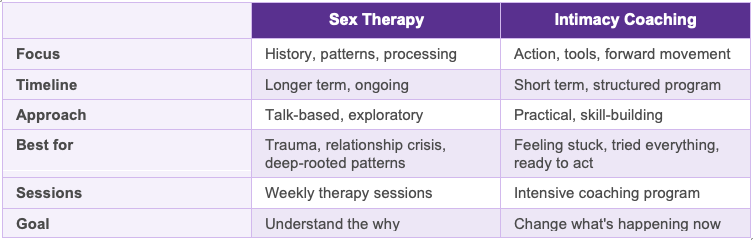
Side by Side: The Real Differences
Here's a quick breakdown so you can see it clearly:
The Thing Nobody Says Out Loud About Therapy
I say this with full respect for therapy, because I am a therapist and I love it and I believe in it deeply for the right situations.
But here's the truth: a lot of women come to me after they’ve been in therapy where they learned a tremendous amount about themselves and still have the same issues with sex they had when they started.
And they think that means nothing will work.
It doesn't mean that. It means they've been using the wrong tool for the job.
Therapy is incredibly effective at helping you understand why something is happening. It is not always effective at changing what's actually happening in your body and your bedroom right now. Because understanding and doing are two completely different things.
If you've spent years understanding your low desire and it hasn't moved, you don't need more understanding. You need action. You need concrete tools, a nervous system regulation practice, a structured approach that gives your body something new to experience, not just your mind something new to think about.
That's not a failure of therapy. That's just the difference between two very different approaches.
So Which One Do You Need?
Here's the honest answer: most of the women who land on this page need coaching.
Not because therapy isn't valuable (it absolutely is) but because the woman who is Googling "intimacy coach vs sex therapist" at 11pm is usually not in crisis. She's not dealing with fresh trauma. She's not in a relationship on the verge of collapse (yet).
She's a woman who has probably already done some version of therapy. Who loves her husband, and he loves her, but they don’t know what to DO about this. She’s stuck because she feels like she’s tried everything. But she’s tired of talking about this problem and ready to actually solve it.
She doesn't need to process more. She needs to act.
If that's you and you've been in your head about this long enough and you're ready for something that gives you a clear path forward with real tools and real results, coaching is where you want to be.
If you're carrying significant trauma that hasn't been addressed, or if there are serious relationship issues underneath the intimacy piece, therapy is the right starting point. And I can help with that too.
But for most women reading this? The Desire to Fire Method is exactly what's next.
Why Having Both Under One Roof Actually Matters
Here's what makes my work different from seeing a coach who is only a coach, or a therapist who is only a therapist.
Because I'm trained in both, I can assess from the start which approach is actually going to help you. I'm not going to put you in a coaching container when what you actually need is clinical support, and I'm not going to keep you in open-ended therapy when what you actually need is to start doing something.
I can also hold both simultaneously. The Desire to Fire Method is a coaching program, but it's built by someone with deep clinical training. Which means the nervous system work, the body-based approaches, and the tools I use are grounded in actual science, not just intuition and good intentions.
You get the depth of a therapist and the action-orientation of a coach. And for most women, that combination is exactly what's been missing.
Ready to Stop Talking About It and Start Doing Something?
You've done enough processing. You know what the problem is. Now it's time to do something about it.
The Desire to Fire Method is my 3-phase coaching program that gives you the tools, the nervous system work, and the clear path forward that therapy alone doesn't provide. If you're ready to actually move the needle, start here.