Feeling Like Roommates With Your Husband? Here's What's Actually Going On
By Erinn Hoel, LCSW | Sex Therapist & Intimacy Coach
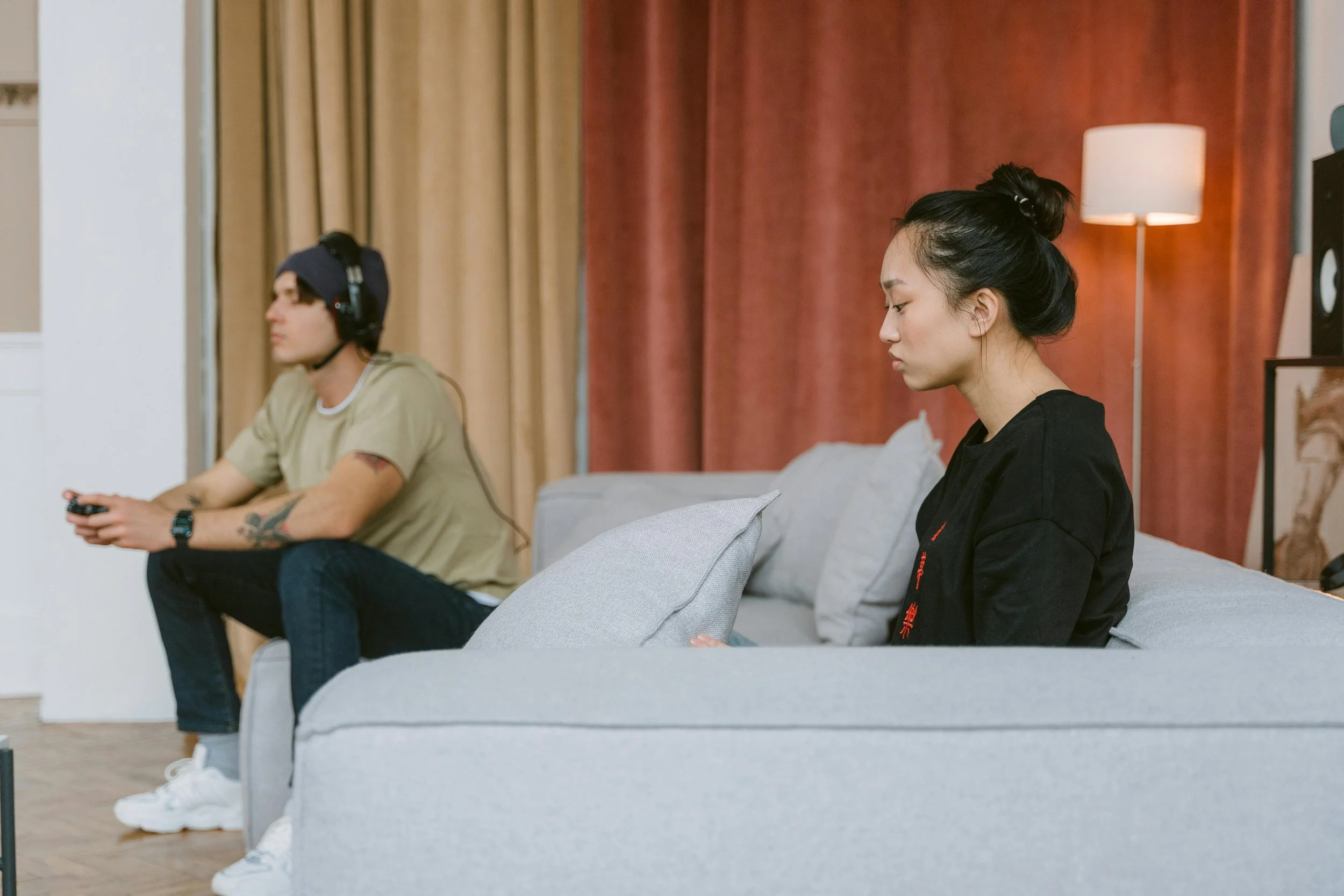
You know that thing where you and your husband are in the same room but you're both just... doing your own thing?
He's on his phone. You're on yours. You talk about logistics like who's making dinner, what's happening this weekend, did you call the plumber. And then you go to bed on your respective sides and do it all again tomorrow.
You love him. You're not unhappy exactly. But somewhere along the way the two of you stopped feeling like partners and started feeling like really good housemates who happen to share a last name.
And the sex (or more accurately, the lack of it) is sitting right in the middle of all of it like the thing nobody wants to name out loud.
Here's the part that makes this so hard to talk about: everything else is fine. Your relationship is good on paper. There's no big dramatic problem. No affair, no major conflict, no obvious reason for the distance. It just crept in. Slowly. And now it's so normal that you're not even sure when it started.
But I want you to understand something important: feeling like roommates is not just a rough patch. It's a sign that something specific has gone offline in your relationship. And it's directly connected to what's been happening with intimacy.
How You Got Here (Without Really Noticing)
It didn't happen overnight. That's part of why it's so disorienting.
It started with the sex stuff. Maybe your desire dropped off. Maybe you started avoiding intimacy. Maybe every time he reached for you, there was this low-grade tension that made the whole thing feel loaded and exhausting. So you started saying no more. And he started reaching out less. And both of you quietly adjusted to a version of your relationship where physical closeness just kind of stopped being part of it.
But here's what most people don't realize: when you remove physical intimacy from a relationship, you don't just lose the sex. You lose the whole ecosystem of connection that physical closeness creates.
The casual touches that say I care about you. The reaching for his hand without thinking about it. The leaning into each other at the end of a long day. The kind of easy physical comfort that makes you feel like you're on the same team.
All of that starts disappearing too. Because your body has learned to be guarded around any physical contact, not just sex. And his has learned not to reach out for you to avoid the rejection.
So now you're two people who love each other, living parallel lives in the same house, wondering how you got so far from the couple you used to be.
Why This Is More Urgent Than You're Treating It
I'm going to be honest with you here, because I think you need to hear it.
The roommate dynamic is one of the most insidious patterns I see in relationships because it's so easy to tolerate. Nothing is acutely wrong. You're not fighting. The kids are fine. Life keeps moving. So you keep telling yourself you'll deal with it later, when things calm down, when you're less busy, when you feel more like yourself.
But later has a way of turning into years. And the longer this goes on, the wider the distance grows and the harder it is to close.
Because here's what's actually happening underneath the surface of a roommate relationship: both of you are slowly accumulating hurt, rejection, and loneliness that never gets addressed. He feels unwanted. You feel guilty and pressured. Neither of you knows how to bring it up without it turning into a thing. So you both just keep managing the distance instead of closing it.
And the scary part? You can love each other completely and still slowly grow apart if this doesn't get addressed. This isn't about whether you love him. It's about whether the connection between you is being maintained.
It's not too late. But it's also not something that fixes itself.
What's Actually Driving the Distance
Here's what I want you to understand: the roommate dynamic in your relationship is almost certainly a symptom of the intimacy issue, not the cause of it.
Most couples I work with think the connection problem is separate from the sex problem. Like if they could just communicate better or spend more quality time together, the intimacy would come back.
But it usually works the other way around.
The low desire and intimacy avoidance creates tension and distance. That distance makes it harder to connect emotionally. The emotional disconnection makes desire even less accessible. Which creates more avoidance. Which creates more distance.
It's a cycle, and it feeds itself.
The nervous system piece is at the root of all of it. When your body has learned to associate sex and physical closeness with stress and pressure, it doesn't just avoid sex. It starts pulling back from all closeness. Because all closeness starts to feel like it could lead somewhere stressful.
This is why you can't just work on your relationship and expect the intimacy to follow. You have to address what's happening underneath first. Which means addressing your nervous system, not just your communication patterns.
The Roommate Phase Almost Cost Me Everything
I'm not going to sugarcoat this part.
There was a period in my relationship where we were so thoroughly in roommate mode that I genuinely couldn't remember what it felt like to be close to my partner. We were functional. We were friendly even. But the warmth was gone and we were both pretending not to notice.
And the thing I didn't understand at the time was that the distance wasn't the original problem. It was what happened after I stopped wanting to be touched, stopped engaging with intimacy, and started managing my way around the whole subject instead of addressing it.
The roommate dynamic was the relationship's response to the intimacy shutting down. And the intimacy had shut down because my nervous system had decided that sex and closeness were things to survive, not enjoy.
Once I understood that, I stopped trying to fix the relationship on the surface and started addressing what was actually going on underneath. And the connection came back. Not all at once. But it came back in a way that felt real instead of performed.
That's what I want for you and your husband. Not just to stop feeling like roommates but to actually get back to the relationship that made you choose each other in the first place.
“We weren't fighting. We weren't miserable. We were just... nothing. Coexisting. And I think we’d gotten so used to it that we stopped noticing how bad it was.
The sex stuff had been an issue for a couple of years but I kept thinking if I could just keep that piece contained, it’d be fine. Erinn helped me see it was all connected. When we fixed the sex piece, the whole relationship shifted. We actually like each other again. We laugh. He can touch me without it feeling loaded. I didn't realize how much I'd missed HIM, and he was missing me too.”
— Maria, married 7 years
How to Actually Fix This (Not Just Manage It)
The instinct most couples have when they recognize the roommate pattern is to address the relationship directly. More date nights. More quality time. More intentional connection.
And those things matter. But they're Phase 3 work. You can't build real reconnection on top of a nervous system that's still treating intimacy as a threat.
The sequence matters:
First, you address the nervous system. Get your body out of survival mode. Break the association between physical closeness and stress. This is what makes everything else possible.
Then you address the pleasure piece. Figure out what actually works for your body, what desire looks like for you specifically, and how to access it without pressure or obligation.
Then you bring your partner into it. Not as the person whose needs you're trying to manage, but as your actual teammate. Because this was never just your problem to fix alone, even if it's felt that way.
This is the exact sequence of the Desire to Fire Method. And the reason it works where everything else hasn't is that it addresses things in the right order instead of trying to build connection on top of a foundation that isn't there yet.
Feeling like roommates is not your forever. But it won't change until the thing underneath it changes.
You Didn't Sign Up for a Roommate. You Signed Up for a Partner.
And that's still possible.
But it doesn't start with more date nights or better communication or trying harder to connect on the surface. It starts underneath all of that, with what's actually driving the distance in the first place.
If this post described your relationship in a way that felt a little too familiar, that's not a coincidence. This is exactly the pattern I help women break inside the Desire to Fire Method. Not by working on the relationship from the outside in, but by addressing the nervous system piece that's been quietly running the show.
Because the roommate dynamic doesn't fix itself. But it absolutely gets fixed when you finally address the right thing.
If you're ready to stop coexisting and actually remember why you like each other and want to spend your lives together, start here.